Monday, April 25, 2005

Poker Royale: Celebrities Take on the Poker Pros

Bill Bruce


I have been contacted to help out with the Poker Royale television production. The celebrities are Traci Bingham, Patrick Warburton, Jennifer Tilley, Mimi Rogers, Morris Chestnut, and Lance Bass. The Poker Professionals are Cyndy Violette, Kenna James, Scott Fischman, Paul Darden, Kathy Liebert, and Roxci Rhodes. Below is more info from the press release:


Poker Royale


For Immediate Release


IS IT A BLUFF? CELEBRITIES TAKE ON THE PROS ON GSN's POKER ROYALE


Are actors better bluffers or will the poker professionals sweep the celebrities in the high stakes game of No-Limit Texas Hold ‘Em? The question will be answered when GSN premieres POKER ROYALE: CELEBRITIES VS. POKER PROS, a seven-episode series debuting as part of GSN’s weekly Casino Night, Friday, May 6 at 9:00PM ET/PT. The announcement was made today by Ian Valentine, Senior Vice President of Programming, GSN.

The latest edition of GSN’s POKER ROYALE franchise sparked witty banter across the table between the pros and the representatives of the fastest growing group in the poker world, celebrity players. Not underestimating their opponents, the experienced pros put on their best game faces in an attempt to make it to the final table for a chance for the $50,000 championship grand prize.

“Our goal is to make our POKER ROYALE series better than other poker shows and this new format of the celebrities challenging the pros is totally cool,” said Valentine. “Viewers will enjoy the unpredictable action, great table talk and top notch poker on both sides.”

The third installment of GSN’s poker franchise will have sideline reporter Lisa Dergan who was named as the sexiest sportscaster by STUFF magazine and also appears on Fox Sports Net’s “Best Damn Sports Show.” Returning as color commentator is professional poker player Robert Williamson III.

In the first six one-hour episodes of POKER ROYALE: CELEBRITIES VS. POKER PROS three professionals and three celebrities face off. Every episode champion wins $10,000 and ten points. The player who finishes second receives eight points, third place receives six points, fourth place receives four points, fifth place receives two points and last place receives zero points. The players who make the final table will each receive $10,000 in chips to begin.

In the two-hour finale, the top three point leaders for both the celebrities and the pros take the top seats. Airing on June 17, the finale winner will take the $50,000 grand prize.


GSN, the Network for Games, is the only U.S. television network dedicated to game-related programming and interactive game playing. The network features game shows, reality series, documentaries, alternative sports programs and casino games. As the industry leader in interactivity, GSN features over 84 hours per week of interactive programming, which allows viewers a chance to win prizes by playing along with GSN’s televised games via GSN.com. Reaching 56 million Nielsen homes, GSN is distributed in the U.S. through all major cable systems and satellite providers. The network is jointly owned by Sony Pictures Entertainment and Liberty Media Corporation. For further media information, visit GSN’s press website at corp.gsn.com.

Source: GSN press


AddThis Social Bookmark Button

Thursday, April 7, 2005

9 On The Town

KCAL


April 7, 2005 – I just received a message from our Public Relations Manager. If you missed the "9 On The Town" segement I was in, it will be re-airing on KCAL at 6:30 pm on April 15th.


AddThis Social Bookmark Button

Tuesday, June 1, 2004

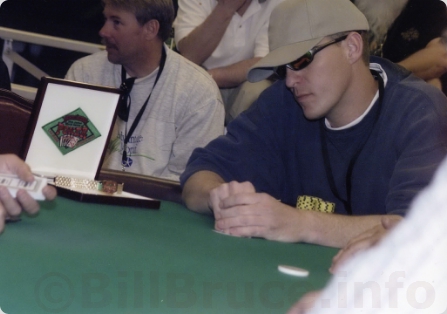
2004 WSOP - Event #1 - 4th place finish

Bill Bruce 2004 WSOP


LAS VEGAS, NEVADA, April 23, 2004 - Prior to yesterday I had never played in the prestigious World Series of Poker. However, I fancy myself a poker player and supplement my income playing cash games. I decided I would try to play this year. So I woke up yesterday morning and made the 5 hour drive from my home in California to Las Vegas. I arrived just in time to get registered and take my seat for the noon starting time. I don't reccommend driving in the same day (I won't be doing it again) because these tournaments are very long and stamina is vital. I am fairly pleased with myself, all things considered, as I ended up finishing in 4th place. Below is the official Tournament Summary.


Official Tournament Report by Nolan Dalla - The World Series of Poker has established a tradition of hosting a special tournament, specifically designed for casino employees. In recent years, the annual casino employees event has marked the "official" beginning of the world's biggest and most prestigious poker tournament -- as dealers, floorpersons, pit employees, bartenders, executives, and personnel from virtually all areas of the gaming business gather at the Horseshoe in downtown Las Vegas to determine who is most deserving as the casino industry's top poker player.

This year, the casino employees "world championship" went to Carl "Coach" Nessel, a 57-year-old former firefighter from Thousand Oaks, CA. The Coach plays poker regularly and works assorted tournaments part-time – including this year's WSOP where he is employed as a Chip Runner. The Coach survived a grueling poker marathon, which lasted an exhausting 15 hours and 45 minutes. He won his final hand of the night with a pair of Queens against the runner up, Cory Pockat, a Poker Dealer from Colorado Springs, CO. The Coach's ride to victory did not come easy.

Two-hundred seventy-nine players started the tournament promptly at 12 noon. It took 11 hours to play down to the final table, comprised of an well-rounded mix of casino employees. Five of the 9 finalists were from California.

Joe Addesso, originally from San Diego – who works as a Table Games Supervisor in Las Vegas -- was the first player to exit in 9th place. He received $2,520.

A short time later, William Roffe was severely short-stacked and exited in 8th place. Roffe, a Poker Dealer who was playing in only his second hold'em tournament ever, had to be proud of his performance. He collected $3,780.
Stephen Calhoun, a Poker Dealer from Bradenton, FL went out next in 7th place – good for $5,040 in prize money.
An hour into the final table, Roger Jenkins, a Casino Shift Manager from Union City, CA, was the shortest stack. He didn't survive and took 6th place, which amounted to a payday of $6,300.
Mark Richman was bounced off the final table in 5th place, when his hand lost to Cory Pockat's straight. Richman, came in second in chips, but could not sustain the momentum he built mid-way through the tournament. Richman, who has won smaller tournaments here in Las Vegas, was awarded $7,560.

Down to four players, Pockat was close to the chip lead with Bill Bruce, with about $45K each in chips. After a short break, blinds increased to $1K-2K, with betting limits at $2K-4K. Pockat took the chip lead when his A-K made top pair at the expense of Bruce. However, Bruce extracted some revenge a few hands later when he was dealt A-A and won a hand against Pockat. "I knew you had aces when I saw your cards," Pockat said jokingly.

However, Bruce's glory was short-lived. He lost a key hand when the final board showed A-10-10-x-x. Bruce flashed an ace (good for top pair). But the Carl "Coach" Nessel showed down a better kicker -- with A-9.

After a few more orbits, Bruce was short-stacked and made his final stand with A-Q versus Pockat's A-10. Bruce was clearly in a dominant position. But a 10 flopped for Pockat, and Bruce failed to hit his queen. The pair of 10s won the hand, and Bruce went out in 4th place. Bill Bruce, a Poker Floorperson, from Menifee, CA who was playing in one of his first ever live tournament, had $8,882 reasons to be extremely proud of his effort.

With three players remaining, Pockat had the chip lead, with about $65K -- versus about $35K each for both the Coach and Leon Wheeler. One of the most important hands of the tournament occurred when the Coach topped Pockat, with A-K against A-Q. Both players caught an Ace on the turn, and put in four bets before the final card was dealt. The Coach didn't need any help, but got it anyway when a king fell on the river – good for top two pair. The key hand (and $40K pot) put the Coach back near the chip lead.

After a few rounds, Wheeler was severely short on chips and made a raise with A-5, which was called by the Coach, holding Q-2. The flop came Q-8-3, giving the Coach top pair. Wheeler was committed and his last chip rolled into the pot. Two blanks fell on the turn and river, and Wheeler's ace-his was topped by the pair of queens. Leon Wheeler, a Las Vegas Poker Dealer who finished 2nd in this event last year, added a 3rd place finish to his remarkable two-year performance in this event. Based on recent history, Wheeler, who took home $11,350, seems destined to win this event at some point in the future.

The two finalists merrily shook hands as heads-up play commenced, just as the clock struck 3 am. The Coach had a slight chip lead, with about $80K to Pockat's $60K. The Coach won the first five pots, and took a sledgehammer to Pockat's diminishing stack size. Within just a few minutes, Pockat's chip position had dwindled to less than $30K. But just when it the Coach might runaway with the victory, Pockat staged a nice comeback. He managed to draw back to even at one point, and it seemed that the duel might continue through the early morning.
However, the Coach squashed Pockat's comeback bid when he was dealt Q-x and made a pair of queens against Pockat's pocket 10s and took nearly half of his opponent's stack. Down to his last $30K, the final hand of the night was dealt at 3:38 am in front of a surprisingly large crowd, given the late hour:

Pockat: Q-9
Coach: J-J

The flop came 9-7-5, giving Pockat top pair (9s). But the Coach played his hand perfectly, letting Pockat commit all his chips on what amounted to an underdog hand. The turn brought a 3 and the river brought a 10, which meant the Coach's J-J was the winning hand of the tournament.

Afterward, Cory Pockat showed a mix of satisfaction and disappointment with the result. "I really thought momentum was on my side when I got back to even (in chips)," he said. "But in the end, he proved to be the better player." Pockat, making his first significant cash in a poker tournament, collected $22,000 as the runner-up.

But the day clearly belonged to the retired California firefighter, who came to the WSOP to work as a Chip Runner, and play poker on the side. "I'm totally speechless," he said, as he stared at the coveted gold bracelet, awarded to each winner at the World Series. "To get to any final table, let alone the World Series, is an accomplishment that goes beyond anything else in poker," the Coach said. "I saw light at the end of the tunnel when I got (heads-up against Pockat), but the light turned out to be a train," he said complimenting his opponent. "I've been coming here since 1976. It's been a dream and a fantasy that I never thought would come true, but here I am."


AddThis Social Bookmark Button

Sunday, December 20, 1998

Tournament Rebuy / Add-on Question


Pocket Aces

Here is a question I posted to a forum. I am going to repost it and one of the responses that I received.


To Rebuy or Not? (Tournament situation)


FROM: Bill Bruce
Date: Sun, Dec 20 1998

Here's the situation:
It's a local Friday night Hold'em tournament…
Start with $600 in chips. 20 min. rounds. Rebuys during (the first) four limits, no rebuys after. A rebuy will get you $800 in chips (2 rebuys max).

At the end of the first (4) four limits ("the break") it is the last chance for any rebuys. I have $1,800 in chips (an upper medium stack), and both rebuys left available to me. (After the break) the limit is going to be $200-$400, with $100 small blind and $200 big blind.

Here's my question:
Should I rebuy? One or Both or None. Why? (There was no add-on option)

Mike Caro advises only adding on if it will build up your stack by a
significant amount (Tournament Tips from the Pros by Shane Smith, 1992). I wish I had a more concrete answer such as a %. One rebuy of $800 is equal to almost half my chips, is that significant?

More Facts on the Situation:
3 tables left. Payout to final table (9 places). I had one of the bigger Medium stacks. Everbody was making both rebuys if available.

What I Did:
I decided to take one rebuy of $800 increasing my stack to $2,600. I felt another $800 was only about 1/3 of my chips and was not warranted.

The Result:
I raised/stole the first two pots netting me $600 almost the amount of a re-buy. They say "Bulldog" Sykes (had a) theory that he'd just get his re-buy chips from the other players.

I went on to finish 5th place... The chips from the re-buy
never really mattered this time, except that my entry fee was now… double (which cut into my overall win).

So is there an answer/ or Rule-of-Thumb:
Perhaps a % amount that makes an add-on worthwhile.
How about in relation to the next limit. (i.e. Enough chips to play one more hand thru to completion.)


RESPONSE:


From: Gregory Raymer
Date: Mon, Dec 21 1998

Rebuy is $15 for T800, or over T50 per $1. These chips are quite a bit cheaper than the original ones you bought, and this argues strongly for making rebuys. Another big factor is your stack size. As has often been said, the more chips in your stack, the less each one is worth. The fewer chips you have, the more each one is worth. Thus, if you are short-stacked, always rebuy, no matter what the blind structure is at that point. If you feel that it is too expensive given that you're only buying enough chips to maybe play one hand, then the tournament was too expensive to enter in the first place.

>I wish I had a more concrete answer such as a %.
>One rebuy of $800 is equal to almost half my chips, is that significant?

Yes. See above.

Given the discount price you were getting, I'd rebuy/addon anytime the new chips increased my stack by at least 25-30%. If the increase is less than 25%, then I'd opt not to take it. If the chips were even cheaper, I would addon anytime my stack increased by some even lower percentage (e.g., if the rebuy were T1000 for $15, I might rebuy anytime my stack would increase by 15-20% or so). In another example, if the rebuy chips are the same price as the original chips, I usually only rebuy if the stack increase will be by at least 50%.

In summary, I'd have done the same as you. Just for different reasons. Remember, if the rebuy or add-on chips are especially cheap, like half-price or less, always take maximum rebuys and add-ons (unless the rebuys are unlimited, at which point take them until the next rebuy won't increase your stack more than about 10%). Again, if you feel that this is too expensive, then the entire tournament is too expensive. Also, the total amount invested isn't of any importance when making a rebuy decision. What you've already spent is gone. The only question is "if I spend this additional $, will my expectation increase by more than that $ amount?" Anytime the answer is yes, rebuy. Even if you've spent a million already, if the next $ amount you spend will increase your expectation by (more than that investment) then taking it is a good bet.

Later, Greg Raymer (FossilMan)


UPDATE:

Greg Raymer would go on to win the 2004 Main Event at the World Series of Poker.


http://blog.billbruce.info


Saturday, June 6, 1998

tech

Technorati Profile